


The Reading Hut®
"On a mission to inspire every child to read, learn, and find joy in words. We publish One, Two, Three and Away! series. Reading the Village with Three Corners early and for pleasure!"

Code Mapping® Tool: The Phonics Word Mapper that Makes Graphemes Visible with our unique Code Mapping Algorithm
Have a Free Play Here!
Use MyWordz® with MySpeekie® to see the Graphemes AND Phonemes - using Phonemies® - Miss Emma's ground-breaking Speech to Print Word Mapper.
MyWordz® Tech : Showing the Code Behind Every Word, in BOTH Directions.
A focus on the letters and sounds in English words is taught through phonics. But explicit instruction in a core set of 100 or so GPCs doesn't help all children become readers. There are 350+ GPCs.
The code mapper lets you type in a word and see its individual letters (graphemes) however MyWordz® also shows the sounds (phonemes) and words mapped in both directions with Phonemies (speech sound monsters). The Reading Hut® build great word mapping tools for teaching phonics and supporting word mapping mastery! MyWordz® embraces linguistic and neurodiversity.

Includes
*MySpeekie
*Map and Drag
*Phonemies Screen
*Monster Mapping Lessons
This Word Mapper shows the graphemes in English words, unlocking phonics


Identifying the graphemes (G) is often far easier for teachers of phonics than identifying the phonemes (P).
Yet they need to do both, and identify the correspondences (C), in every word to support all learners - especially those with dyslexia.
If we want children to store words in their orthographic lexicon and stop guessing, we need to make the grapheme to phoneme correspondences (GPCs) visible and precise. That starts with teacher knowledge and confidence.
Learn to use MyWordz® word mapping tech so you can confidently identify the graphemes and phonemes in every word of English, regardleess of accent, and support children in doing the same.
What is Word Mapping?
Word mapping is the process of making the structure of a word visible by linking speech sounds and print in both directions. In reading, the child matches each grapheme in a word to the phoneme it represents. In spelling, the child listens to the word, identifies each phoneme in order, and selects a grapheme to represent every one of those phonemes. In both cases, the goal is the same: no sounds are missed or blurred. Accurate reading and spelling depend on every phoneme being represented by a grapheme so the word can be stored securely in memory and recognised or produced automatically in future.
This principle aligns with the Reading Framework, which defines a grapheme as a letter or group of letters that usually represents a single phoneme, and explains that the number of graphemes in a word usually corresponds to the number of phonemes, hence the term grapheme–phoneme correspondence (DfE, 2023, p. 34).
The Framework also notes that, in a small number of cases, one grapheme can represent two phonemes, such as the letter u in uniform, which represents /j/ and /u:/. Within the Spelling Framework (DfE, 2013), and referenced again in the Reading Framework (DfE, 2023, p. 47), phonics is described as continuing to play an important role in spelling beyond Key Stage 1, with teachers expected to draw pupils’ attention to grapheme–phoneme correspondences that do and do not fit with what has been taught so far. Word mapping supports this expectation by making phoneme–grapheme relationships explicit in both reading and spelling, and by giving learners a reliable way to work with any word they meet.
Children who proficiently map words are able to identify word mapping errors in phonics materials!

Can you map words to show the graphemes?
Orthographic mapping happens when children develop Word Mapping Mastery. This is the ability to link phonemes to graphemes across whole words. Some children develop this with relative ease after a kick-start of phonics. Phonemic awareness is crucial, which is why we developed the 10 Day Speech Sound Play Plan. By screening for dyslexia risk early and embracing learning differences, we can prevent unnecessary reading and spelling difficulties. The Reading Hut Ltd is the first to show both graphemes and their sound values for all English words with Phonemies, in ways that support linguistic and neurodiversity and can be understood by all children. They can be changed for accents!
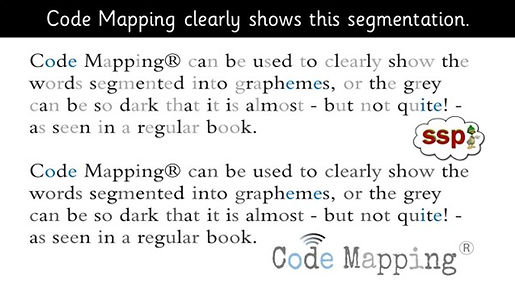


The 'Orthographic Word Mapping Tool' :
Show the Code!
Type words and see the graphemes. You can change the mapping of words locally: if you think any words have been mapped incorrectly in the Word Bank let us know! See any words in red? Let us know.
The option to subscribe for mapping unlimited text, and to copy the orthographically mapped text into a document is available in the MyWordz tech! MyWordz.tech


Sight Words are also
Orthographically Mapped!
We've mapped various lists
- see the ICRWY Lessons and new Monster Spelling Piano app
Also watch them mapped with 'Phonemies' (Speech Sound Monsters) and write them while watching and listening. This is Duck Level 1


.png)